
No time to read now?
-> Download the article as a handy pdf
List of contents
WHO is an important source of information, but is it always right?
Martti’s ramblings about the WHO and number of deaths caused by ADRs
Martti Ahtola | Feb 9, 2022

Information published and communicated by the World Health Organization (WHO) is trusted by nations, the authorities, and by the people. In the past two years we have relied on the WHO for COVID-19 related information (for good reasons). Information coming from WHO is simply regarded as the truth. If health related information is considered true and important, it can lead to legislative changes and impact the practices of private enterprises.
However, WHO does not have a crystal ball from which they can pull new information that nobody else has access to. Sure, they have their own large databases of data collected through international collaboration, but when it comes to topics where large amounts of pre-determined data had not been gathered into a database, WHO uses the same scientific sources and research results as anyone else. And WHO employees are just people, as far as we know.
It may just be that, in some cases, WHO research is not necessarily the one truth. And blindly accepting it, because it’s from WHO, can be misguided.
Estimated number of mortality, hospital admissions and healthcare spending
Recently, while doing research for our upcoming blog post about identification of medicinal products (IDMP) implementation, I noticed a familiar piece of information about drug safety in the UNICOM Handbook (IDMP in a capsule). The document states:
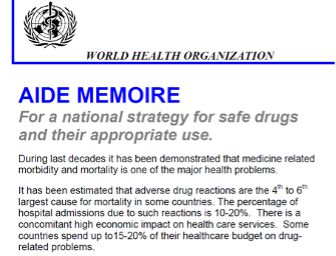
“The World Health Organization estimates that adverse drug reactions are the fourth to sixth largest cause for mortality in some countries. The percentage of hospital admissions due to such reactions is 10-20%. And, there is a concomitant high economic impact on healthcare services. Some countries spend up to 15-20% of their healthcare budgets on drug-related problems.”
While I do not yet have that kind of expertise in IDMP to say whether the UNICOM document is otherwise factually correct, I had a hunch that this statement may not exactly be fully correct.. The UNICOM document uses as its reference WHO’s Aide Memoire: For a national strategy for safe drugs and their appropriate use. The above quote is almost word-to-word from the aide memoire.
 Part 1 and Part 2). The current EU pharmacovigilance legislation is based on similar estimates and our research showed that the figures for mortality and hospitalization were grossly overestimated and are not supported by national statistics of the EU Member States.
My conclusion was that either WHO has researched the impact of adverse drug reactions on mortality, hospitalization and healthcare spending, or that they were using similar sources as European Commission.
Communication with the WHO
The memo did not contain a reference for these figures, so I contacted the WHO asking what the reference was. I suspected that they would refer to the European Commission documents from 2008 which essentially had numbers taken from thin air (if you are still reading this, and haven’t done so already, I would suggest reading our blog about the death rates).
The initial response from WHO was that they could not find this document and were asking me if I meant another one of their memos (one about safe and appropriate use of injections). And yes, that day when they responded in mid-December, the above link was not working. However, it is working now, and one would hope that WHO has an internal document management system in use.
Luckily, I had downloaded the document, so I was able to send it to them even before the link started working again. The person I was communicating with found out that the document had been produced at their headquarters in Geneva and looped in a colleague from the office. They asked me to request a permission to reproduce or translate WHO publication. I submitted the form.
As a response to my request, I got a question if my request was about the memo about safe and appropriate use of injections (yes, again). Nowhere in my request for permission was this other memo mentioned. I explained once again which memo I meant and sent for the third time a link to the memo.
WHO responded that Aide Memoire: For a national strategy for safe drugs and their appropriate use is an older document, and that they were not sure if it was still up-to-date and that they would put me in contact with the technical people responsible for the document.
The Source
The “technical person” told me that memo is an old document and it has not been updated and that “some source data of the document can be found in this article in 1998”: Incidence of adverse drug reactions in hospitalized patients: a meta-analysis of prospective studies, J Lazarou, BH Pomeranz, and PN Corey, 1998.
If you read our previous blog, you might notice that this article was one of the two articles that the European Commission used as a basis for their estimates on the number of deaths and hospitalization caused by ADRs. The technical expert at WHO also suggested to read more up-to-date information about the topic and suggested a 2016 review article about adverse drug reactions.
While it is always a good idea to read more up-to-date information about any topic, the suggested article was not really about the topic we were discussing. However, the article contains the following part:
“Seminal research undertaken in the late 20th and early 21st century in the USA and the UK demonstrated that ADRs are a common manifestation in clinical practice, including as a cause of unscheduled hospital admissions, occurring during hospital admission and manifesting after discharge.3–6 The incidence of ADRs has remained relatively unchanged over time, with research suggesting that between 5% and 10% of patients may suffer from an ADR at admission, during admission or at discharge, despite various preventative efforts.”
Those references 3 – 6 that this statement is based on are again the same 1998 article from Lazarou et al., and in addition 1993, 2004 and 2009 articles about the number of hospital admissions caused by adverse reactions to medicinal products. Interestingly, the 2004 BMJ article introduces the topic in the following way:
“Lazarou and colleagues suggested that adverse drug reactions (ADRs) caused over 100 000 deaths in the United States in 1994.1 However, this study was criticised for various reasons, including that the death rate was extrapolated from admission rates in 1994, yet based on rates of ADRs taken from studies conducted before 1981.2 Publication bias may have also contributed to what many investigators regard as inflated mortality data.”
Conclusion
It is again important to highlight a couple of things. First, I think pharmacovigilance is important work and that people are dying and being hospitalized because of adverse reactions caused by medicinal products. Second, WHO should be considered a reliable source of information and people should make decisions about their health and about the health of others based on scientific data.
However, it still seems to me that much of the activities performed around pharmacovigilance are based on no scientific data and there is no continuous monitoring of the actual effectiveness of these activities. Also, in the current day and age, relying on any data source (even the WHO) blindly, is just reckless. Nobody should do it, especially if your decision affect thousands or millions of other people.
Did you like the article? Share with your network!
…or tell us your opinion.

Follow our newsletter!
Keep up with industry trends and get interesting reads like this one 1x per month into your inbox.

Learn more about Tepsivo
We deliver modern PV solutions to fulfill your regulatory needs using less resources. See how we do it >


0 Comments